Demographic and clinical characteristics of patients cureus.
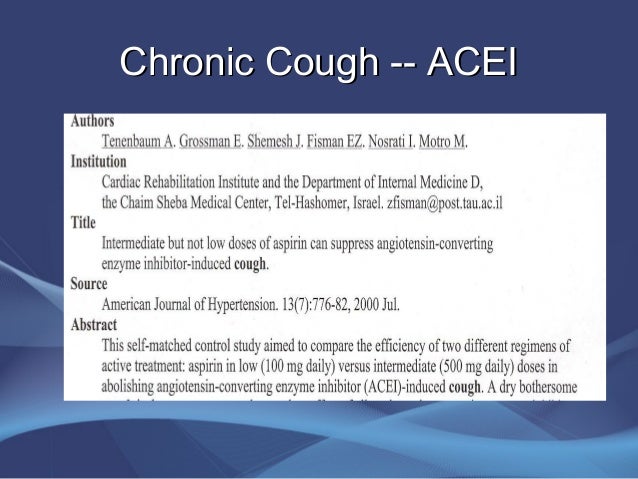


Oct 17, 2016 in conclusion, acei-induced cough is a frequently observed adverse side effect that might be suspected based on literature reports. its diagnosis . History of ace inhibitor-induced cough was found to be an independent risk factor for developing ace inhibitor-related angioedema in one retrospective cohort study. the mechanism of ace inhibitor-induced cough is not precisely known, although it may involve increases in bradykinin, prostaglandins, thromboxanes, and/or substance p. Mar 25, 2020 · angiotensin-converting enzyme (ace) inhibitors and angiotensin receptor blockers (arbs) reduce intraglomerular pressure by inhibiting angiotensin ii ̶ mediated efferent arteriolar vasoconstriction. [] these drugs also have a proteinuria-reducing effect that is independent of their antihypertensive effect. Half of these cases usually occur within a week of starting the acei but can occur years later. this is a class specific reaction not a drug specific and arbs can cause the same reaction even though these drugs don’t effect the kinin metabolism. 50% of patients with angioedema due to an arb also had an acei induced angioedema (cicardi, m.
↑moore pk, et. al. management of acute kidney injury: core curriculum 2018. am j kidney dis. 2018; 72: 136-148. ↑ eiser ar et al. phlebotomy for pulmonary edema. Inhibitory konwertazy angiotensyny, acei (z ang. angiotensin-converting-enzyme inhibitors) grupa leków stosowanych w terapii nadciśnienia tętniczego, niewydolności serca, choroby acei induced cough niedokrwiennej serca, cukrzycowej chorobie nerek i nefropatii nadciśnieniowej oraz cukrzycy i zespołu metabolicznego. pierwszym acei wprowadzonym na rynek był kaptopryl.
Ace Inhibitorinduced Angioedema Uptodate
Hypotension, hyperkalemia, dizziness, and headache and a persistent dry cough are some of the common side effects of aceis. this cough is characterized by a . Jun 01, 2020 · history of ace inhibitor-induced cough was found to be an independent risk factor for developing ace inhibitor-related angioedema in one retrospective cohort study. the mechanism of ace inhibitor-induced cough is not precisely known, although it may involve increases in bradykinin, prostaglandins, thromboxanes, and/or substance p [ 66,67 ]. May 21, 2015 ace inhibitor induced coughinstructional tutorial videocanadaqbank. comvideo: youtu. be/h0rmfecofow. 1. 1 background patients with cough frequently present to clinicians working in both primary and secondary care. 1,2 acute cough, which often follows an upper respiratory tract infection, may be initially disruptive but is usually self-limiting and rarely needs significant medical intervention. chronic cough is often the key symptom of many important chronic respiratory diseases but may be.

Jun 01, 2020 · history of ace inhibitor-induced cough was found to be an independent risk factor for developing ace inhibitor-related angioedema in one retrospective cohort study. the mechanism of ace inhibitor-induced acei induced cough cough is not precisely known, although it may involve increases in bradykinin, prostaglandins, thromboxanes, and/or substance p [ 66,67 ]. Abstract. cough is one of the common adverse effects in patients receiving angiotensin-converting.
Angiotensin-converting enzyme inhibitor-induced cough.
Inhibitory Konwertazy Angiotensyny Wikipedia Wolna
More answers from ask the pharmacist. one of the telltale adverse effects of ace inhibitors, including lisinopril, is a chronic, hacking cough — a potential side effect that patients often don't hear about. studies suggest that up to a third of all patients taking an ace inhibitor will develop this type of chronic dry cough, and the cough often doesn't go away when they stop taking the drug. Treatment of ace inhibitor-induced cough. carla a. luque, pharm. d. and mariola vazquez ortiz, pharm. d. angiotensin-converting enzyme (ace) inhibitors are . Mar 25, 2020 · valsartan is a prodrug that produces direct antagonism of angiotensin ii receptors. it displaces angiotensin ii from at1 receptors and may lower blood pressure by antagonizing at1-induced vasoconstriction, aldosterone release, catecholamine release, arginine vasopressin release, water intake, and hypertrophic responses.
Jul 14, 2015 the mechanism of acei-induced cough is not certain. aceis block the proteolytic enzyme angiotensin i-converting enzyme (ace), which cleaves . A dry, tickly and often bothersome cough is the most common adverse effect of ace inhibitors. recent studies indicate that cough may develop in around 10% of the patients treated with ace inhibitors. in half of these patients, the ace inhibitor has to be discontinued. cough has emerged as a class effect occurring with all ace inhibitors with no clear difference between the single substances. Been described in studies of patients presenting for the evaluation of chronic cough. the onset of ace inhibitor-induced cough ranges from within hours of the first dose to months after the initiation of therapy. resolution typically occurs within 1 to 4 weeks after the cessation of therapy, but cough may linger for up to 3 months.
↑moore pk, et. al. management of acute kidney injury: core curriculum 2018. am j kidney dis. 2018; 72: 136-148. ↑ eiser ar et al. phlebotomy for pulmonary edema in dialysis patients. Inhibitory konwertazy angiotensyny, acei (z ang. angiotensin-converting-enzyme inhibitors) grupa leków stosowanych w terapii nadciśnienia tętniczego, niewydolności serca, choroby niedokrwiennej serca, cukrzycowej chorobie nerek i nefropatii nadciśnieniowej oraz cukrzycy i zespołu metabolicznego.
Background: angiotensin converting enzyme (ace) inhibitors cause coughing in 5-10% of patients, but the exact mechanisms of this effect are still unclear. in . Sep 11, 2019 the acei-induced cough may be severe enough to push the patients towards the discontinuation of therapy in some cases. enalapril was most . Cough as a side-effect of angiotensin-converting enzyme (ace) inhibitor therapy occurs in up to 20% of women and 10% of men. only rarely is it severe enough to cause the patient to stop taking the drug. pier luigi malini and colleagues (july 5, p 15)1 offer a new option to the physician faced with a patient acei induced cough racked by ace-inhibitor-induced cough. Ace inhibitor-induced angioedema is a rare but potentially fatal adverse effect of the class of medications that inhibit angiotensin converting enzyme (acei). it typically presents in the first weeks after starting the acei as swelling of the face, lips, or tongue in the absence of itch or urticaria.
The acei induced cough cough induced by ace inhibitors may also disappear spontaneously despite continued therapy, usually after about 4 months. 4 however, we have not. A persistent dry cough is a relatively common adverse effect believed to be associated with the increases in bradykinin levels produced by ace inhibitors, although the role of bradykinin in producing these symptoms has been disputed. many cases of cough in people on ace inhibitors may not be from the medication itself, however.
Sep 01, 2020 · mechanism acei induced cough of acei-induced cough. although the exact mechanism of acei-induced cough remains unclear, several theories have been postulated for cough development. degradation of bradykinin and substance p by ace and their subsequent accumulation in upper and lower respiratory tracts by aceis is the most widely accepted theory. Recommendation 1. in patients presenting with chronic cough, in order to determine that the ace inhibitor is the cause of the cough, 2. in patients presenting with chronic ace inhibitor-induced cough, discontinue therapy with the drug because it is the 3. in patients whose cough resolves after.
0 Response to "Acei Induced Cough"
Post a Comment